

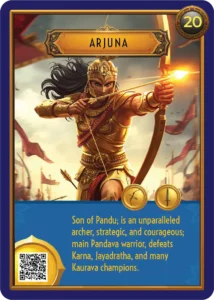









• Example: Players must decide how many Army cards (5–25 LP) to commit to each battle. Using too many strong cards early secures short-term wins but risks leaving the team weak later.
• Justification: This requires foresight, planning, and resource allocation, sharpening players’ ability to think several moves ahead.

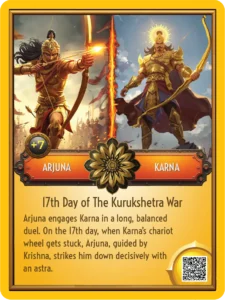
• Example: Event cards often give situational bonuses (e.g., Bhima vs Duryodhana gives +7 LP to Bhima). Players must evaluate whether to risk fighting or forfeit the event.
• Justification: By weighing evidence, risks, and multiple factors, players strengthen reasoning and evaluation skills.

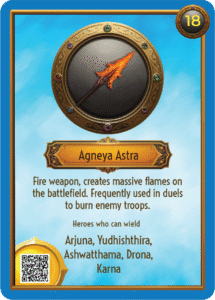
• Example: During the Raising Phase, players must decide whether to reveal powerful Astras now or save them for future battles.
• Justification:Because each decision is irreversible and time-sensitive, players learn to choose effectively under uncertainty and pressure.

• Example: If a player cannot pay the required Battle Points with Army LP, they must trade an Astra for LP. This forces creative adjustments with fewer resources.
• Justification: Players practice adaptability and creative thinking by finding alternative solutions to setbacks.

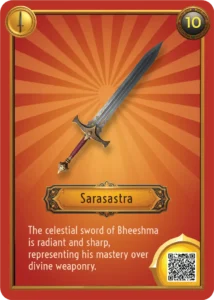
• Example:In team play, players can trade Astras or Shastras but must balance exchanges fairly. Negotiation and coordination are crucial to winning as a team.
• Justification: The game fosters communication, cooperation, and negotiation skills, teaching players to balance personal advantage with team success.

• Example:Using too many Army LP for one win weakens future battles. Sacrificing Astras for LP impacts long-term combat ability.
• Justification: Players learn to understand interdependencies, feedback loops, and cause-effect dynamics, building holistic systems awareness.