
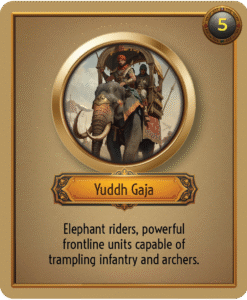
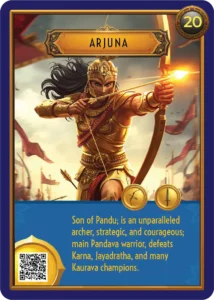
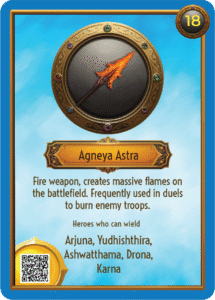
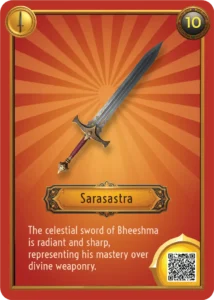








Armies
War Units

Warriors
Pandavas & Kauravas

Astras
Divine Weapons

Shastras
Physical Weapons

Events
War Triggers

Life Skills Developed through the Mahabharata – Kurukshetra Card Game

The Mahabharata – Kurukshetra Card Game is not only engaging and culturally enriching, but also a powerful medium for developing essential life skills. By making decisions, facing setbacks, managing resources, and collaborating with teammates, players practice skills that are directly transferable to real-life situations.

1. Decision-Making & Judgment

  • Game Example: In the Raising Phase, a player must decide whether to reveal a powerful Astra (like Vyavastra +18 LP) immediately or save it for future battles.
  • Life Skill: Players learn that every choice has consequences — quick wins may be costly in the long term.
  • Justification: This nurtures thoughtful decision-making, mirroring real-world choices where risks and opportunities must be weighed.

2. Patience & Self-Control

  • Game Example: Facing an unfavorable Event card (e.g., Duryodhana’s +7 LP), a player may choose to forfeit rather than waste strong resources.
  • Life Skill: Teaches restraint and patience — small losses may protect long-term strength.
  • Justification: This builds emotional regulation and planning ability, valuable in academics, work, and relationships.

3. Resilience & Coping with Loss

  • Game Example: A player who loses a battle must pay Battle Points, sometimes sacrificing powerful Astras or Army cards.
  • Life Skill: Develops resilience — the ability to bounce back from setbacks and continue competing.
  • Justification: Reinforces perseverance, grit, and the understanding that failure is not final.

4. Resource Management

  • Game Example: Limited Army LP, Warriors, Astras, and Shastras must be distributed across multiple battles.
  • Life Skill: Builds budgeting and prioritization skills.
  • Justification: Reflects real-life management of time, money, and energy, teaching balance and foresight.

5. Collaboration & Teamwork

  • Game Example: In team play, players can trade Astras and Shastras but must negotiate fair trades and align strategies.
  • Life Skill: Strengthens communication, trust, and negotiation skills.
  • Justification: Mirrors workplace and family collaboration, where teamwork ensures success.

6. Ethical Thinking & Fair Play

  • Game Example: Players must pay Battle Points even when it weakens them — respecting the rules is central.
  • Life Skill: Teaches honesty, integrity, and respect for fairness.
  • Justification: Reinforces ethical conduct as a guiding principle in life.

7. Adaptability & Problem-Solving

  • Game Example: Players must pay Battle Points even when it weakens them — respecting the rules is central.
  • Life Skill: Teaches honesty, integrity, and respect for fairness.
  • Justification: Reinforces ethical conduct as a guiding principle in life.

By engaging with the Mahabharata – Kurukshetra Card Game, players practice vital life skills such as judgment, patience, resilience, resourcefulness, collaboration, ethics, and adaptability. The game is both an immersive cultural experience and a powerful tool for life skill education across ages.

Thinking Skills Developed through the Mahabharata
Kurukshetra Card Game

The Mahabharata – Kurukshetra Card Game is more than entertainment; it is an educational tool that develops a wide range of thinking skills. Through battles, resource management, and team play, players enhance strategic foresight, critical reasoning, decision-making, problem-solving, collaborative abilities, and systems thinking. Below is a detailed analysis with examples from the game.

1. Strategic Thinking

• Example: Players must decide how many Army cards (5–25 LP) to commit to each battle. Using too many strong cards early secures short-term wins but risks leaving the team weak later.

• Justification: This requires foresight, planning, and resource allocation, sharpening players’ ability to think several moves ahead.

2. Critical Thinking

• Example: Event cards often give situational bonuses (e.g., Bhima vs Duryodhana gives +7 LP to Bhima). Players must evaluate whether to risk fighting or forfeit the event.

• Justification: By weighing evidence, risks, and multiple factors, players strengthen reasoning and evaluation skills.

3. Decision-Making Under Pressure

• Example: During the Raising Phase, players must decide whether to reveal powerful Astras now or save them for future battles.

• Justification:Because each decision is irreversible and time-sensitive, players learn to choose effectively under uncertainty and pressure.

4. Problem-Solving & Adaptability

• Example: If a player cannot pay the required Battle Points with Army LP, they must trade an Astra for LP. This forces creative adjustments with fewer resources.

• Justification: Players practice adaptability and creative thinking by finding alternative solutions to setbacks.

5. Collaborative & Social Thinking

• Example:In team play, players can trade Astras or Shastras but must balance exchanges fairly. Negotiation and coordination are crucial to winning as a team.

• Justification: The game fosters communication, cooperation, and negotiation skills, teaching players to balance personal advantage with team success.

6. Systems Thinking

• Example:Using too many Army LP for one win weakens future battles. Sacrificing Astras for LP impacts long-term combat ability.

• Justification: Players learn to understand interdependencies, feedback loops, and cause-effect dynamics, building holistic systems awareness.

The Mahabharata – Kurukshetra Card Game strengthens diverse cognitive skills: strategic foresight, critical reasoning, fast and effective decision-making, adaptability, teamwork, and systems thinking. This makes it both a powerful cultural experience and an educational tool that sharpens minds across ages.